
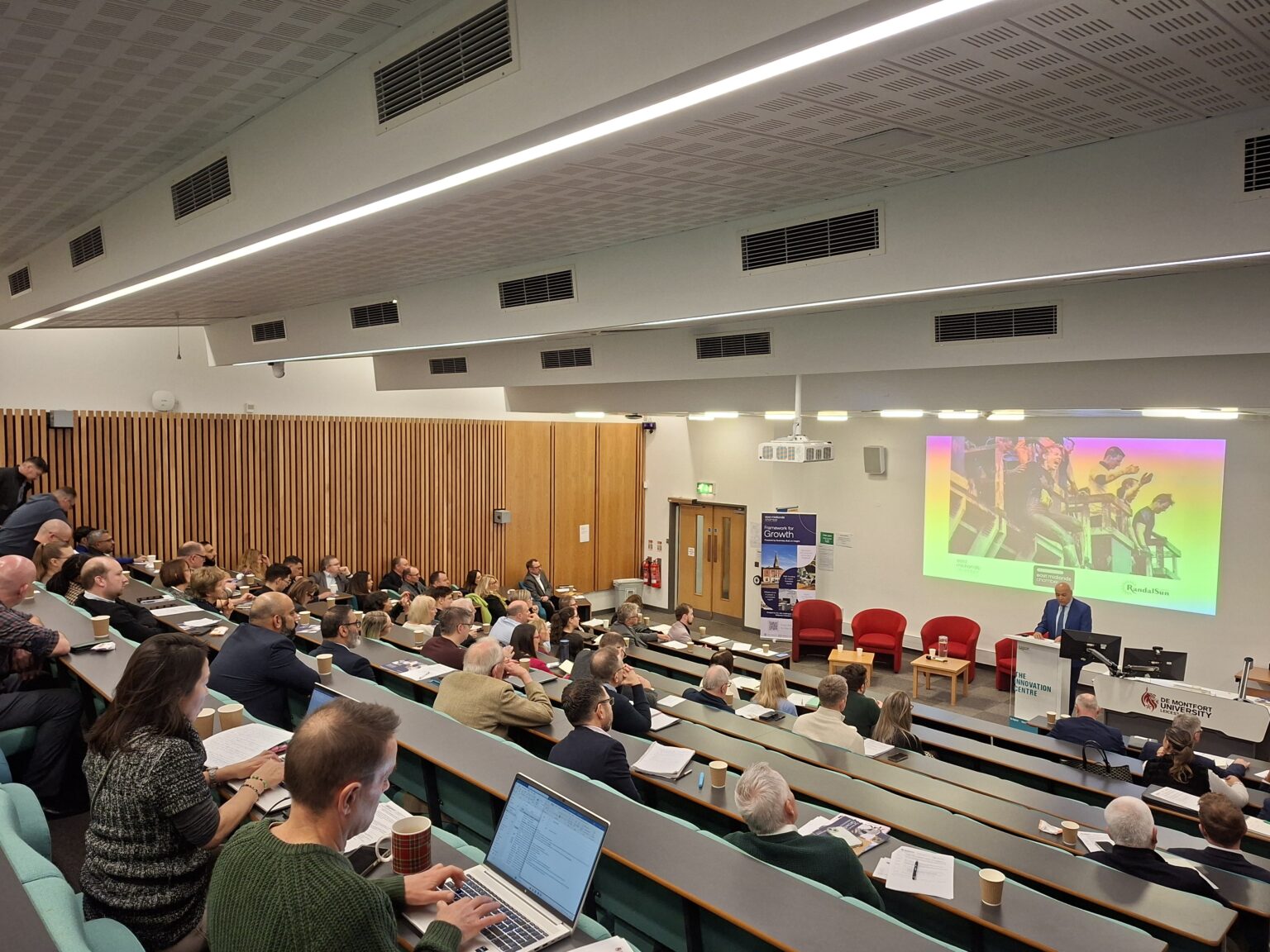
Business leaders, academics, and public sector representatives gathered at De Montfort University for the East Midlands Future Flux Economic and Innovation Conference. This event assessed the region’s economic performance in 2025 and identified areas for growth.
Hosted by the university and supported by RandalSun Capital, the programme featured keynote sessions and panel discussions centred on innovation, productivity, and workforce development. Delegates reviewed the challenges highlighted in recent economic data, including weakened business investment and ongoing uncertainty following last year’s Budget. Speakers noted the need for a more stable policy environment to support future planning.
East Midlands Chamber Director of Policy and Insight Richard Blackmore shared key asks to political leaders from the Chamber’s recently launched Framework for Growth, alongside research data gathered from firms across the region. Speaking afterwards he said: “Research carried out by the Chamber across 2025 has continually shown a sense of fragile confidence among businesses in the region and getting firms, the education sector, economic experts together in one place starts conversations, builds ideas and helps navigate the economic pressures collectively faced.
“Holding this conference in the same week that the Chamber’s Framework for Growth for the East Midlands was released – a landmark document setting out key asks to political leaders across are areas like infrastructure, innovation, skills investment and planning – made the event all the more timely.
“That document outlines what the region needs to enable growth and a conference that unpicks the economic challenges and explores opportunities firms have identified with sharing of research data, insight from academics and from the Bank of England is extremely useful in achieving growth as we go forward.”
The conference brought together SMEs, large corporations, voluntary organisations, universities, and funding bodies to strengthen collaboration across sectors. Participants discussed how unified regional action could help address inflationary pressures, labour shortages, and slow productivity gains. Insight was also shared on national economic headwinds and their implications for the East Midlands.
Panellists examined the structural barriers facing the region, including limited political coordination and historic underinvestment. There was broad agreement that stronger collaboration, clearer regional advocacy, and greater confidence among firms will be essential to unlocking growth opportunities in 2026.
Sessions also explored how businesses are responding to real-world market conditions, with contributors highlighting the value of sharing practical approaches to innovation and enterprise across the region.